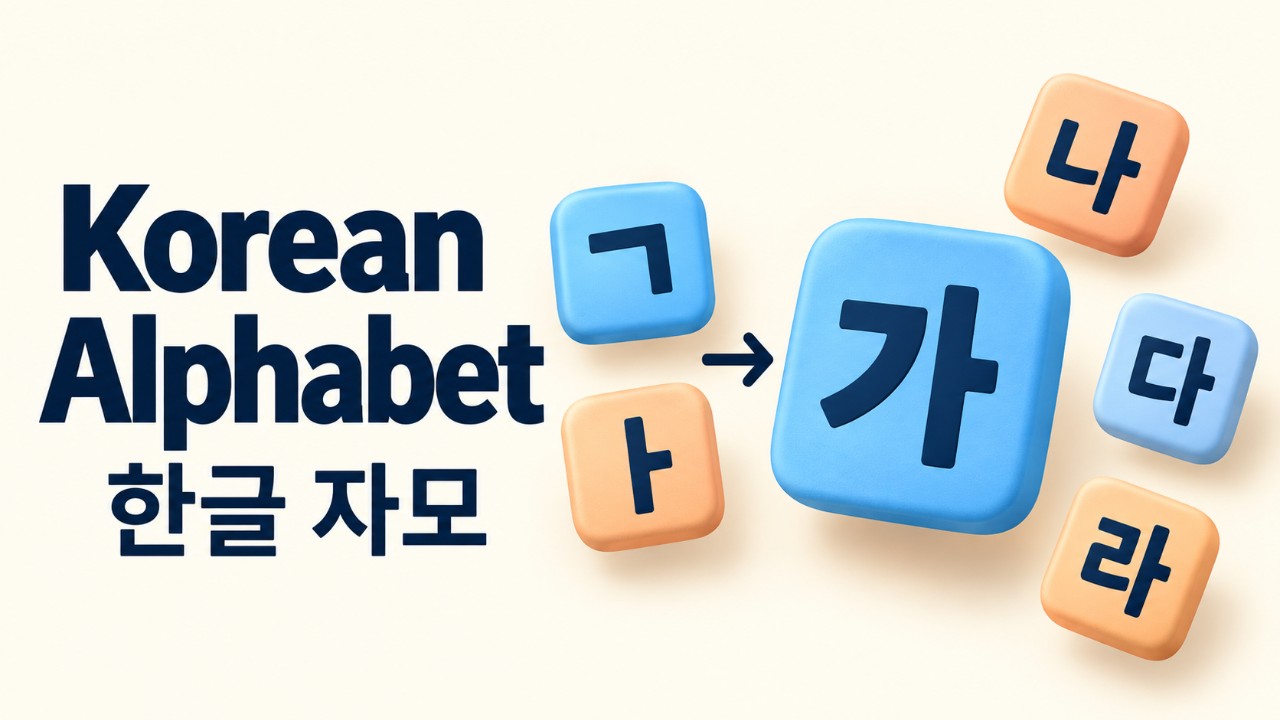
Korean has its own alphabet, Hangul. This guide follows lessons 1 to 7 of KoreanClass101's "Learn to Read and Write Korean" series on YouTube. When you finish, you will know 10 basic vowels and 14 basic consonants. You will also be able to read words like 우유 (milk) and short sentences like 어디 가요? (Where are you going?).
If you want to practice while you read, the flashcard deck below has 104 cards made from the same seven videos.
Korean Alphabet with 'Learn Korean with KoreanClass101.com'
Learn Korean (English) · 104 flashcards
How a Korean syllable is built
Hangul letters are not written in a single line like English letters. They are grouped into blocks, and each block is one syllable. Lesson 1 gives the rule you will use most: every block needs at least one consonant and one vowel.
So what happens when a syllable starts with a vowel sound? Korean puts the circle ㅇ, called 이응, in the consonant spot. At the start of a syllable it has no sound. It only holds the place.
The word 이 (teeth) is ㅇ + ㅣ, and it sounds like the vowel ㅣ by itself. 아이 (child) is two blocks: ㅇ + ㅏ, then ㅇ + ㅣ.
Vowels: lessons 1 to 3
Lesson 1: ㅇ, ㅏ, ㅣ
The first lesson teaches two vowels, ㅏ and ㅣ, together with ㅇ. These three letters are enough to write two words: 이 (teeth) and 아이 (child).
Lesson 2: ㅑ, ㅓ, ㅕ
Look at the short strokes. ㅏ has one stroke on the right side and ㅓ has one on the left. Add a second stroke and you get ㅑ and ㅕ.
The new words are 야, an informal way to say "hey," and 아야, which means "ouch." At the end, the video asks whether you can recognize the letters you have learned so far.
Lesson 3: ㅗ, ㅛ, ㅜ, ㅠ, ㅡ
The lesson starts with a helpful observation: if you rotate the first five vowels, you get the new ones. The video then reads them side by side, first ㅗ ㅏ ㅜ ㅓ and then ㅛ ㅕ ㅠ ㅑ, so you can hear each pair.
It also sorts vowels into two groups. Tall vowels (ㅣ ㅏ ㅑ ㅓ ㅕ) stand to the right of the consonant. Fat vowels (ㅗ ㅛ ㅜ ㅠ ㅡ) lie under it. Compare 이 and 오: same ㅇ, but the vowel moves from the side to the bottom.
With all ten vowels you can read 오이 (cucumber), 여우 (fox), 우유 (milk) and 이유 (reason). You also meet 요, a polite ending that goes at the end of a sentence. It comes back in every sentence later in this guide.
Consonants: lessons 4 to 7
Each consonant lesson uses the same steps. The video shows how to write the consonant, reads it with each vowel, and then uses it in words. The rows of syllables are easy reading practice, because only the vowel changes from one block to the next.
Lesson 4: ㄱ, ㅋ, ㅎ
The ㄱ row reads 기 가 갸 거 겨 그 구 규 고 교. ㅋ looks like ㄱ with one extra line, and the video says 키 and 기 one after the other so you can hear the difference.
The words in this lesson are 여기요 (Excuse me, or Here, please), 가요 (I'm going) and 휴가 (vacation). Put the last two together and you get your first sentence: 휴가 가요. I'm going on vacation.
Lesson 5: ㄴ, ㄷ, ㅌ, ㄹ
This is the longest lesson in the deck, with 23 cards. You learn 나 (I, me), 너 (you, informal), 누구 (who), 어디 (where) and 우리 (we, us).
Many of the other words come from English: 기타 (guitar), 스티커 (sticker), 아티스트 (artist), 터키 (Turkey) and 라디오 (radio). They make a good test. Read one aloud before you look at the meaning, and see if you recognize the English word.
The lesson ends by putting 어디 in front of 가요: 어디 가요? Where are you going?
Lesson 6: ㅁ, ㅂ, ㅍ
The words here are 머리 (head), 바보 (fool) and 피부 (skin). The lesson also teaches 아파요, which can mean "I'm sick" or "It hurts," and builds sentences with it.
Lesson 7: ㅅ, ㅈ, ㅊ
The last lesson teaches 사요 (I buy) along with 사자 (lion), 차 (car) and 치즈 (cheese). Most of the cards in this lesson are short shopping sentences.
Your first Korean sentences
From lesson 4 on, the videos keep returning to three verbs. Put a word in front of the verb and you have a complete sentence.
가요 (I'm going): 휴가 가요. I'm going on vacation. 어디 가요? Where are you going?
아파요 (It hurts): 머리 아파요. My head hurts. 피부 아파요. My skin hurts. 어디 아파요? Where does it hurt?
사요 (I buy): 우유 사요. I buy milk. You can swap in 노트 (notes), 치즈 (cheese), 모자 (a hat), 차 (a car), 바지 (pants) or 치마 (a skirt).
All three verbs end in 요, the polite ending from lesson 3.
Practicing with the deck
The deck has 104 cards in the same order as the videos. Each card plays its clip from the lesson, so you can watch the letter being written and hear how it sounds. Some cards ask you to write or say a letter. Others show a word and ask whether you can read it before you see the answer. After each card, you rate how well you remembered it, and the deck uses that rating to decide when to show the card again.
Start with lesson 1 and move on when those cards feel easy. The deck stops before final consonants (받침), the consonants written at the bottom of a block, so that is the next thing to learn after these seven lessons.
Korean Alphabet with 'Learn Korean with KoreanClass101.com'
Learn Korean (English) · 104 flashcards